
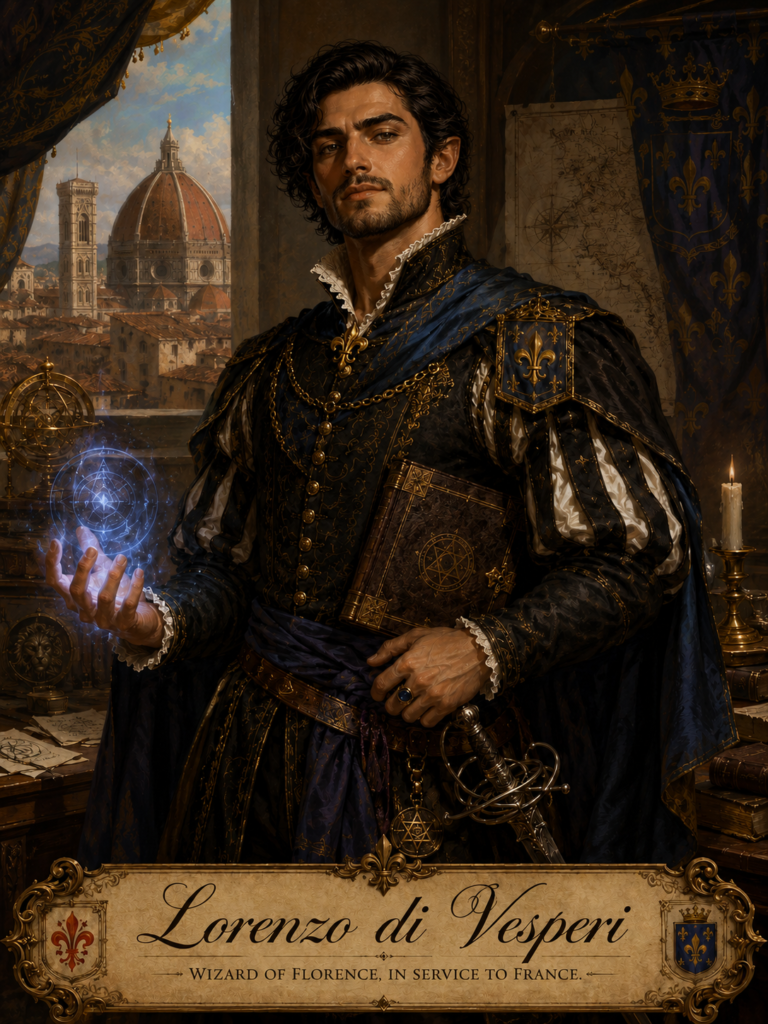
23 November 1699 — Frankia
I begin this fourth volume because the third has become an archaeological site.
One can scarcely find yesterday beneath the receipts, calculations, sketches of coastlines, discarded incantations, and several pages devoted to an argument with Master Bellacourt regarding the proper representation of marshland. He maintained that beauty must sometimes prevail over precision. I suggested he take up portraiture.
A map which is beautiful and false is merely a well-dressed lie.
This journal shall be better ordered.
I leave Frankia in one month.
The commission bears the seal of a man whose name opens doors faster than a battering ram. His Excellency has entrusted me with the survey of certain territories in the New World—coasts, river approaches, settlements, roads where they exist, and suitable places for them where they do not.
It is the greatest professional honor yet offered to me.
Naturally, it is also dangerous, inconvenient, and likely to involve insects of uncommon ambition. I accepted at once.
There are moments when a man sees the next stone in the path before him. He may step upon it or remain where he is and explain, at great length, why advancing would have been unwise.
I have never cared for such explanations.
If I complete this commission well, my name will be known in courts where the name Vesperi presently means nothing. Wealth may follow. Influence may follow wealth.
And perhaps, one day, a Bardi will be obliged to consider me worthy of consideration.
I shall not write Fiona’s name often. Writing a thing gives it power.
27 November 1699
Frankia
My final examinations in advanced survey thaumaturgy concluded today.
The Frankians adore examinations. They believe truth becomes more respectable when placed behind a desk and guarded by three elderly men in robes.
I was required to map a valley I could not see, identify the course of two underground streams, estimate the height of an obscured ridge, and explain why the village represented on the examiner’s original chart could not possibly exist where he had placed it.
The village was his own addition to the exercise.
He did not enjoy my answer.
He enjoyed the corrected map even less.
I passed.
Afterward, Master Bellacourt presented me with the quill.
It is made from a feather so black that candlelight seems reluctant to settle upon it. The nib is silver, etched with letters too fine to read without magnification. When placed against prepared parchment, it draws toward the shape of the surrounding world as a compass draws north.
Within thirty miles, terrain reveals itself.
Not perfectly. No magic worthy of respect is ever as simple as its seller claims. The quill shows land, water, elevation, roads, and structures of sufficient size. It does not tell me whether a road is guarded, whether a house is abandoned, or whether the pleasant valley ahead is inhabited by men who collect foreign cartographers’ heads.
For such details, one must still use the eyes.
Or send someone else first.
Bellacourt told me the quill was not a gift lightly given.
I told him I was not a man lightly equipped.
He laughed, which was generous of him.
1 December 1699
Frankia
There are places where power announces itself with trumpets.
Frankia prefers architecture.
Its avenues are broad enough for armies. Its ministries occupy buildings that lesser nations would call palaces. Even the clerks possess clerks. A man may spend an afternoon climbing a staircase merely to discover that the correct staircase is in another province.
Yet the machine works.
That is the disturbing part.
Frankia is not great because its nobles are wiser than those of Latria, nor because its soldiers are braver, nor because its mages have discovered secrets denied to the rest of us. It is great because all these things have been made to pull in roughly the same direction.
Florence has genius enough to illuminate the world and pride enough to ensure that each lamp is carried down a different street.
I remain Latrian. No amount of Frankian wine, tailoring, or instruction will alter that.
Still, I have learned their language, their manners, and the useful distinction between what a Frankian says, what he means, and what he expects you to pretend he meant.
It is a civilized country.
I shall miss it.
6 December 1699
Frankia
My passage has been arranged.
I am to travel north and cross into Prittonia, then proceed to Liverpool. There I will board a merchant vessel called the Silver Gullet.
The name does not inspire confidence.
A silver falcon, perhaps. A silver crown. Even a silver eel might suggest speed and determination.
A gullet suggests only that something is about to be swallowed.
His Excellency’s secretary assured me the vessel is dependable, well commanded, and accustomed to Atlantic crossings. It carries spices and passengers, among other lawful cargo.
The phrase “among other lawful cargo” has the polished surface of language designed not to be examined too closely.
I asked no further questions.
This may have been discretion.
It may also have been laziness.
Time will judge.
12 December 1699
On the Road North
Frankia recedes behind me.
The winter fields are gray, the roads wet, and the inns united in their determination to serve the same stew under different names.
I travel with two trunks, one case of instruments, my spellbook, three blank atlases, the quill, a rapier, and enough clothing to convince strangers that I am a gentleman.
The last is sometimes the most useful equipment.
At each stop, someone asks whether I am a merchant.
When I say I am a cartographer, they look disappointed.
When I add that I am a wizard, they become polite.
There is a lesson there.
I have thought often of Florence during the journey. Of the Vesperi house. Of Thalia correcting my manners while Francisco pretended not to smile. Of the narrow streets, tiled roofs, bells in the morning, and the great families behaving as though God Himself had signed their genealogies.
I have also thought of my mother.
Fianicia possessed no house, no title, and no freedom. Yet half of what I am came from her.
The world insists that this should count for less.
The world is wrong.
Unfortunately, being wrong has never prevented the world from enforcing its opinion.
17 December 1699
Prittonia
Prittonia is like Frankia after someone has removed the polish and improved the beer.
The language called Common has always served me well in trade, scholarship, and travel, but the Prittonian tongue sits near enough to it to produce constant small betrayals. A familiar word arrives wearing an unfamiliar hat. Sentences turn where I expect them to continue. Men swallow half their syllables and appear proud of the economy.
They understand me.
I understand most of them.
This is generally sufficient until money or insults are involved.
The countryside is green despite the season, though the sky appears to have been constructed from damp wool. Chimneys rise above every town. The roads are crowded with carts, livestock, sailors, tradesmen, and people who seem to have made haste their religion.
Liverpool lies ahead.
Beyond Liverpool lies the sea.
Beyond the sea lies my fortune.
Or my grave.
The two have shared an address before.
21 December 1699
Liverpool
Liverpool smells of coal smoke, tar, fish, wet rope, horse dung, salt water, and ambition.
It is not Florence.
No one would mistake the two cities even after suffering a blow to the head.
Yet there is a vitality here that I respect. Ships crowd the harbor like petitioners before a throne. Cargo moves constantly—crates, barrels, canvas-wrapped bundles, livestock, passengers, sailors, and men whose business is best conducted without names.
I saw the Silver Gullet from the quay.
She is broad in the beam, weathered, and less ridiculous than her name. Her hull bears scars from prior crossings, which means either that she is durable or that Providence has repeatedly failed to finish the task.
My patron has purchased my passage and arranged a guest cabin in the fo’c’sle.
I met with Captain Finch and concluded the final arrangements. We sail on the morrow.
A small bird for a man commanding an ocean vessel, but I have learned not to judge men by names. Mine means more than society allows and less than I sometimes pretend.
Tomorrow is my last full day on Prittonian soil.
22 December 1699
Liverpool, Late Evening
I had intended a quiet evening.
This was my first error.
The common room of the inn was crowded when two sailors entered looking for work. The first was a human named Dáithí O’Baille, an Ivernian with an easy manner and the alert eyes of a man who considers unattended property a philosophical question.
His companion was Kaelan, a goliath of considerable size and very little apparent concern for the structural limitations of furniture.
Kaelan is a freedman.
I learned this later.
At first, I knew only that he watched doors, measured men quickly, and smiled whenever violence became possible.
We had scarcely become acquainted when Captain Finch entered with several men attached to the king’s service. Their uniforms had the usual effect upon the room: conversations shortened, backs straightened, and several patrons discovered urgent interest in their cups.
At a nearby table, four men had been discussing Parliament, representation, and the possibility that a monarch might be required to listen to those he rules.
The idea was new to me.
Not the desire to restrain power. Every court in Latria is devoted to restraining someone else’s power. But these men spoke of representation as a principle rather than a weapon. They suggested that authority might rise from beneath instead of descending from above.
Dangerous thoughts.
Interesting thoughts.
A pamphlet lay upon their table.
One of the king’s men found it.
The room became very still.
Kaelan announced that he had been reading the pamphlet.
He had not written it. He did not own it. I am not entirely certain he had seen it before that moment.
He claimed it anyway.
There are men who step between another man and a blade because conscience demands it. There are others who do so because they enjoy blades.
Kaelan may be both.
The king’s men questioned him, threatened the room generally, and issued warnings severe enough to preserve royal dignity without requiring them to test whether Kaelan could be arrested without damaging the building.
Then they left.
I bought a round for the house.
It seemed the proper response to surviving politics.
O’Baille decided that the four men whom Kaelan had protected owed him and Kaelan additional drinks. The four men disagreed. Their disagreement acquired weapons.
For a moment, the matter balanced delicately between foolishness and bloodshed.
Then one of my new acquaintances produced a concealed blunderbuss.
This improved everyone’s judgment.
The locals lowered their weapons and departed, leaving several behind. A flintlock pistol came into my possession during the confusion.
I gave it to the barkeep to return.
Keeping it would have been theft.
Also, I have no idea how to fire the damned thing.
Kaelan and O’Baille retained four other weapons. Their moral reasoning evidently differs from mine in matters of battlefield salvage.
Captain Finch had observed the entire performance. Rather than summoning the watch, he offered both men berths aboard the Silver Gullet.
This tells me much about Captain Finch.
He values capable men.
He is tolerant of disorder when it benefits him.
And he may be insane.
He bought drinks, dealt cards, and told stories until the candles had burned low. O’Baille matched him cup for cup with the determination of a man attempting to drown an ancestral enemy.
Kaelan seemed unaffected.
I retired before wisdom became impossible.
A journey begins in the morning.
23 December 1699
Aboard the Silver Gullet
The morning began with pounding at my door.
At first, I believed it to be the judgment of God.
It was Kaelan.
O’Baille stood behind him in a condition suggesting that God’s judgment had already arrived and was taking its time.
We were late.
Not disastrously late, but late enough that respectable sailors were already working and less respectable sailors had begun pretending they had been working for hours.
The three of us made our way to the docks together. Kaelan carried his belongings as though they weighed nothing. I carried what dignity remained after hurrying through Liverpool behind a goliath and an Ivernian who stopped several times to be sick.
The Silver Gullet was alive with departure. Lines were cast off and retied. Cargo vanished below. Orders crossed one another in the air. Gulls screamed with the confidence of creatures exempt from naval discipline.
Kaelan and O’Baille reported as crew and were assigned to the berthing below.
I reported as a passenger and was shown to the guest cabin in the fo’c’sle.
The difference was immediate.
We had arrived together, but aboard ship a man’s place is measured quickly: officer, sailor, passenger, servant, cargo.
Captain Finch reprimanded the two of them for their lateness. He might have done worse, but my arrival with them complicated the matter. A captain may punish new sailors for delaying departure. It is less convenient to complain when the commissioned passenger whose patron paid handsomely for passage arrives at the same moment.
Finch gave them a warning.
O’Baille attempted to look attentive while turning a shade of green usually associated with pond water.
I have secured my instruments, stored the quill, and placed this journal inside the writing shelf.
The shore is beginning to move away.
Or perhaps we are.
There are philosophers who would insist the distinction matters.
The river widens before us. Liverpool fades into smoke and gray stone. Beyond lies the sea, and beyond that, lands I have never seen but have been paid to draw.
A month ago, I possessed a commission.
Today, I have a ship.
That is progress.
Whether it is progress toward fortune, ruin, or some more interesting destination remains to be seen.